






























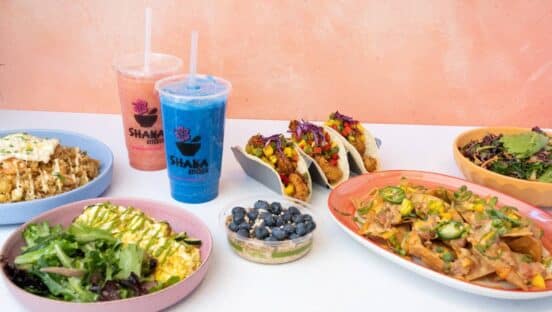
Hess says that for his customers, price is not the deciding factor. Instead, his customers tend to forgo the convenience and affordability of traditional fast-food outlets and value the cleaner food sold by his brand. “In general, we don’t compete for McDonald’s customers,” Hess says. “They’re more than likely not going to value the health consequences of our burger over the consequences of another fast-food product.”
The unavailability of hormone- and pesticide-free food on a large national scale has been the campaign du jour of critics like Michael Pollan, who wrote in his second New York Times best-seller In Defense of Food, “The more eaters who vote with their forks for a different kind of food, the more commonplace and accessible such food will become.” That might be true, but often the barriers to entrance for consumers looking to buy into the Utopian organic market are too high—in other words, the food is too expensive.
While consumers understand that organic foods mean an increased ticket price, according to retail research group Technomic, they’re only willing to pay a 10 percent to 15 percent premium on the items. Eighty percent of organic consumers will not pay more than a 15 percent premium.
The goal of making organics affordable to all socioeconomic levels is difficult to achieve says The Hartman Group’s Demeritt. According to her, “Demographics don’t really do a good job anymore of who is going to use organic or not.” While widespread access to affordable organic food continues to be a societal challenge, Demeritt reports that the majority of organic users (52 percent) are from households making $50,000 or less. But earning $70,000 a year makes a consumer more likely to be an organic user than the general population. “So it is likely that if you’re making a lot of money that you’ll be a user than not, but because that’s such a small portion of the population, we know that the majority of people who are using organic are not people who are particularly well off compared to others,” she says. Really Cool Foods is hoping to tap into the masses by opening a 77,000-square-foot commissary in eastern Indiana, allowing the company to provide more than 30 million pounds of organic and natural foods to grocers across the county.
While today the widespread availability of organics remains an unachieved goal, consumers might be moving on faster than the industry can keep up. According to The Hartman Group’s findings, consumers are already replacing organic foods with local ones. Part of the shift could be because consumers never really took the time to find out what “organic” means. “People use ‘organic’ as shorthand for whatever they want to associate with it, their level of understanding around it is pretty minimal, and the point of the matter is they don’t really care,” Demeritt says.
But Brown contends that his customers shouldn’t be counted out just yet. “They aspire to understand, and they desire to eat food that’s not heavily processed or latent with chemicals or ranched with antibiotics and hormones,” he says. Neither he nor McCabe of O’Naturals is worried about the rising popularity of competing labels like “local,” “fresh,” or “artisan,” saying each of those often describe their organic offerings as well.
“Once people stick their toe in the water, they want to start going all the way,” McCabe says. “When you see ‘fresh’ and ‘artisan’ then the next thing you’re going to do is try it.”
The increasing popularity of fair-trade products follows the same early trajectory of organics a decade ago. According to market research firm Mintel, 284 fair-trade products were introduced in 2008 compared with 130 the year before and just 17 in 2003.
Despite competition from other socially responsible or health-conscious labels, Demeritt doubts this is the death of the organic market. “It’s not that organic is going to go away. It’s just over time, things change and other attributes become more important,” she says. “Organic will probably always be there, but it’s already not enough.”